The Universe is filled with energetic particles, electron and
fully ionized atoms, that roam space with a velocity very
close to the speed of light. Collectively, these particles are
known as cosmic rays, and their origin is one of the
fundamental unsolved problems in modern astrophysics.
The charged energetic particles, that make up cosmic rays, are
a very dilute medium; each particle carries a very high
energies, but the particles themselves are very few. Per
volume, cosmic rays contain as much energy as the gas and the
magnetic field between the stars and as the total light in a
Galaxy. The processes that determine the energy and spatial
distribution of cosmic rays are different from those that
shape ordinary gases on earth, because they rely almost
entirely on electric and magnetic fields. Most gases on Earth
are thermal: the energy of the gas is distributed
approximately equally among the atoms or molecules of the
gas. In contrast, matter in the Universe is often far from any
equilibrium. In the dilute plasmas that fill most interstellar
and intergalactic space, nature chooses to endow a small
number of particles with an extreme amount of energy. We
witness a fundamental self-organization that, through
interactions between particles and electromagnetic fields,
arranges the atoms and available energy in three components: a
cool or warm gas that carries the bulk of the mass, cosmic
rays with a wide range of energies, and the turbulent
electromagnetic fields that link the two. Why does nature
produce cosmic rays? Also, what is the fate of the turbulent
magnetic field? Do interactions of cosmic rays generate the
large-scale magnetic field that permeates the Universe?
It appears that efficient acceleration of cosmic rays proceeds
in systems with outflow phenomena, in which a fraction of the
flow energy can be transferred to cosmic rays. One of those
system are shell-type supernova remnants (SNR), in which
material from the exploded star slams into the ambient gas,
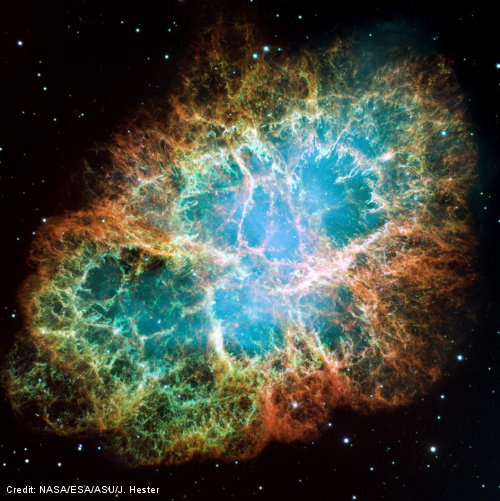
thus forming a shock front. The figure shows an optical image
of the Crab Nebula, which is about 1000 years old. In fact,
SNRs have long been suspected as production sites of Galactic
cosmic rays on account of the flow energy and the supernova
rate. The question of cosmic-ray acceleration in SNRs includes
aspects of the generation, interaction, and damping of
magnetic turbulence in non-equilibrium plasmas. The physics of
the coupled system of turbulence, energetic particles, and
colliding plasma flows can best be studied in young SNRs, for
which X-ray and gamma-ray observations indicate very efficient
particle acceleration and the existence of a strong turbulent
magnetic field.

We conduct intensive simulations in which we follow individual
particles as they move in electric and magnetic
fields. Directly ahead of SNR shocks one expects that cosmic
rays drift relative to the ionized interstellar gas, which is
an unstable situation. The movie shows simulation results for
that scenario: The top panel indicates the turbulent magnetic
field and the bottom panel depict the density of interstellar
gas. Initially the interstellar gas is at rest and the cosmic
rays drift to the left. Note that after a while the structures
in both the magnetic field and the gas density appear to drift
as well. In the end there is no relative drift between cosmic
rays and interstellar gas, and the growth of magnetic field
terminates. This saturation can only be captured in kinetic
studies.